
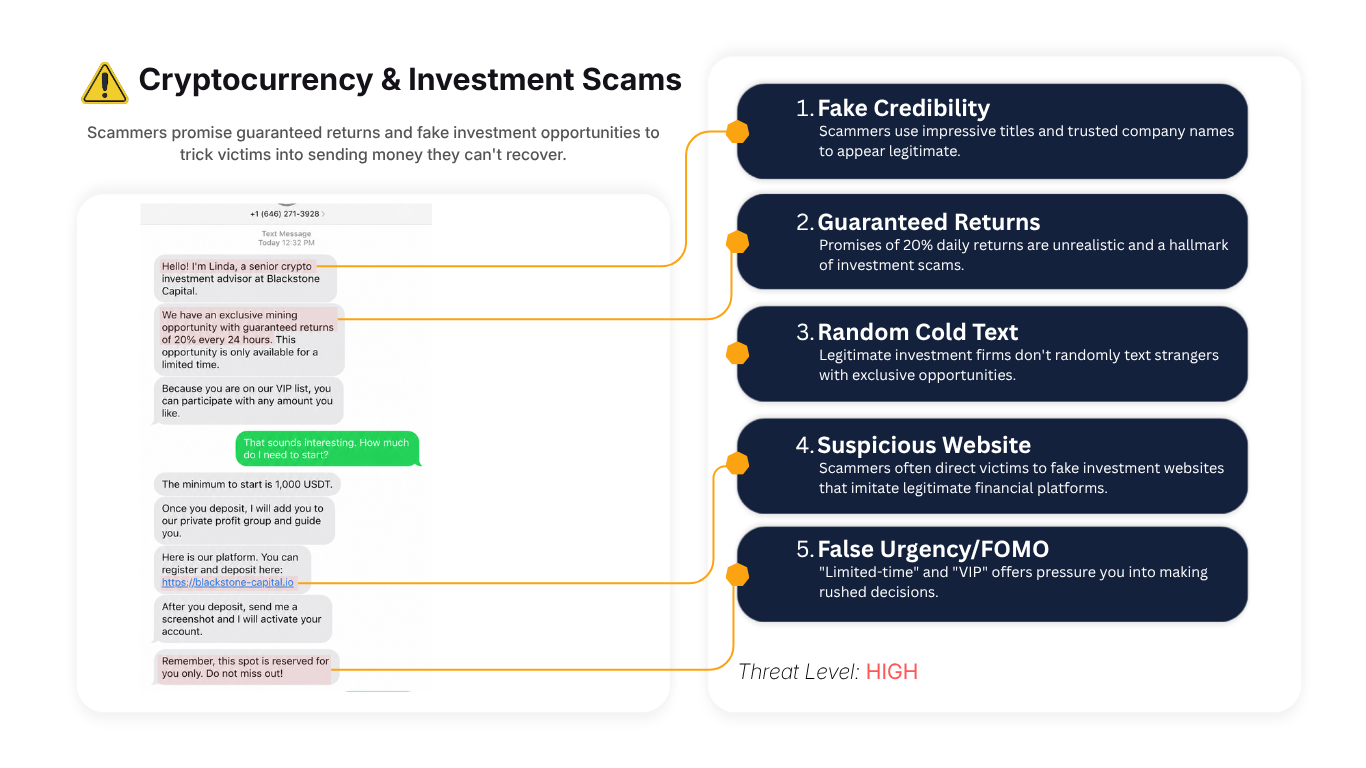
Illustration representing cryptocurrency and investment scams

What Are Cryptocurrency & Investment Scams?

Cryptocurrency and investment scams occur when criminals trick people into putting money into fake investment opportunities, fraudulent trading platforms, or digital assets that do not deliver what was promised.


Scammers may promise unusually high returns, claim they have exclusive financial opportunities, or pretend to be experienced investors who can help you make money. Some build trust over time before encouraging their targets to invest.


These scams can involve cryptocurrency, stocks, foreign exchange trading, real estate, or other investments. Fraudsters may even display fake account balances and profits to make an investment appear successful.


Important: Cryptocurrency and legitimate investments carry financial risks, but a scam involves deception designed to steal money or sensitive information.

Legitimate Example

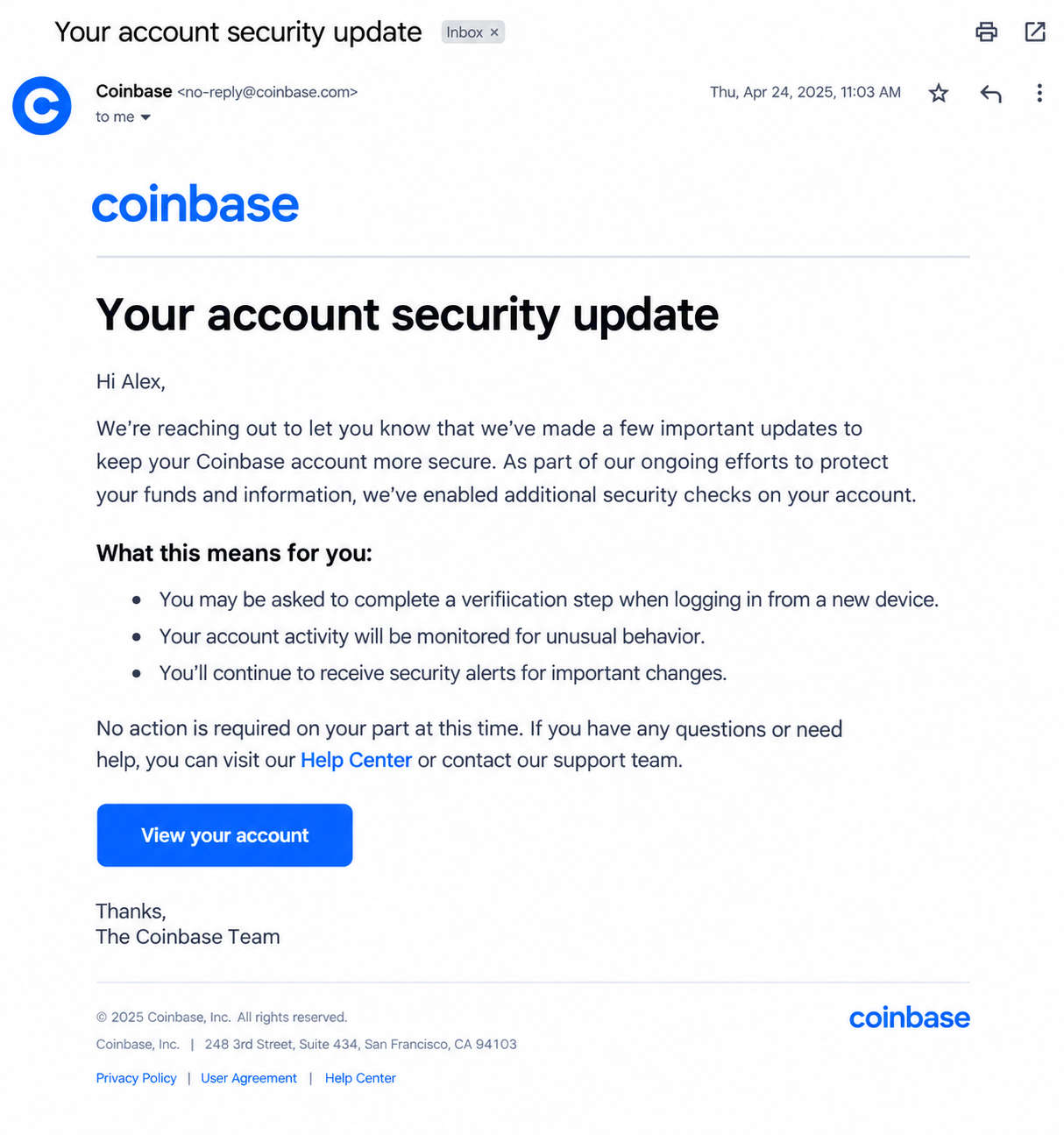
Example of a legitimate investment opportunity

A legitimate investment provides information about its risks, fees, and how it operates. The provider can be independently researched, and returns are not presented as guaranteed or risk-free.


Remember: legitimate investments can lose value. Always research the provider and understand the risks before committing money.

Scam Example

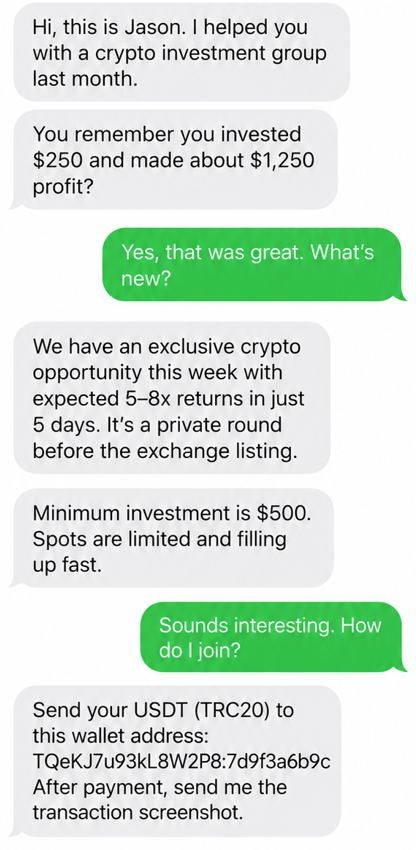
Example of a fraudulent cryptocurrency investment offer

A stranger promises that a small cryptocurrency deposit will generate enormous profits in a short time. They direct you to an unfamiliar platform that displays growing returns but demands additional payments before you can withdraw your money.


Remember: fake profits, guaranteed returns, and fees demanded to release your funds are major warning signs.

How Cryptocurrency & Investment Scams Work

Investment scammers use persuasive promises, fabricated evidence, and psychological pressure to convince people to transfer money.


1. An Investment Opportunity Appears

You see an advertisement, receive a message, or meet someone online who claims to have a profitable investment opportunity. They may promise quick returns or access to an exclusive trading system.

2. The Scammer Builds Trust

The person may share supposed success stories, fabricated testimonials, fake credentials, or screenshots showing impressive profits. Some scammers develop personal relationships with their targets before discussing investments.

3. You Are Encouraged to Invest

The scammer directs you to a website, app, or cryptocurrency wallet and asks you to deposit money. An initial small deposit may appear to generate profits to encourage a larger investment.

4. Fake Profits Encourage Larger Deposits

The platform may display fabricated gains, while the scammer pressures you to invest more. The displayed balance does not necessarily represent real or withdrawable funds.

5. Withdrawals Become Impossible

When you try to withdraw, the scammer may demand extra taxes, processing charges, deposits, or account-unlocking fees. Eventually, communication may stop and the money may be unrecoverable.

Cryptocurrency Scams

Fraudsters exploit interest in digital currencies by promoting fake tokens, fraudulent exchanges, bogus mining opportunities, or cryptocurrency investment platforms.


  • Fake cryptocurrency exchanges or wallets
  • Fraudulent token sales and coin launches
  • Requests to transfer cryptocurrency to an unknown wallet
  • Fake giveaways that promise to multiply your deposit

Investment & Trading Scams

Scammers pretend to be financial professionals or advertise investment systems that promise unusually high returns with little or no risk.


  • Fake stock or foreign exchange trading platforms
  • False claims of guaranteed investment profits
  • Fraudulent investment groups and paid signals
  • Fake testimonials and fabricated performance records

Relationship-Based Investment Scams

Some scammers build a friendship or romantic relationship online before introducing an investment opportunity. This is sometimes called a relationship investment scam or “pig butchering” scam.


  • Someone you meet online offers to teach you investing
  • They insist you use a specific unfamiliar platform
  • They display profits to persuade you to invest more
  • They request extra payments when you try to withdraw
Warning Signs / Red Flags
  • Guaranteed profits: Someone promises unusually high or consistent returns and claims the investment has no risk.
  • Pressure to act quickly: You are told to invest immediately or lose access to a supposedly exclusive opportunity.
  • Unsolicited investment advice: A stranger contacts you through social media, messaging apps, or a dating platform and quickly recommends an investment.
  • Unverified platforms: You are directed to an unfamiliar website or app that cannot be independently verified.
  • Fake account balances: A platform displays large profits but will not let you withdraw funds without additional payments.
  • Extra withdrawal fees: Someone demands additional deposits for supposed taxes, verification, or account release before returning your money.
  • Requests for cryptocurrency transfers: You are pressured to send digital currency to a personal wallet or an address supplied by an unknown person.
  • Secrecy and isolation: The person discourages you from consulting family members, trusted adults, or a qualified financial professional.
  • Fake endorsements: An advertisement uses a celebrity's image, a fabricated news article, or an alleged expert endorsement that cannot be verified.
  • Requests for account access: Someone asks for your wallet recovery phrase, private key, password, or remote access to your device.
How to Stay Safe
  • Research before investing: Independently investigate the company, platform, and people promoting the opportunity. Do not rely solely on testimonials or links supplied by the promoter.
  • Be skeptical of guaranteed returns: Every investment involves some degree of risk. Promises of extraordinary profits without risk should be treated with caution.
  • Verify registrations and credentials: Check relevant regulatory resources, such as the U.S. Securities and Exchange Commission's Investor.gov. A registration claim should be verified independently and does not guarantee that an investment is safe.
  • Avoid rushed decisions: Do not invest because someone says an offer will disappear in minutes or that you must act before doing research.
  • Protect your wallet: Never share your private keys, recovery phrase, or account passwords. Legitimate support staff should not need your recovery phrase.
  • Do not trust displayed profits alone: Screenshots and online dashboards can be fabricated. A displayed balance is not proof that funds can be withdrawn.
  • Be careful with online relationships: Treat investment advice from a person you have only met online with caution, especially if they push you toward a particular platform.
  • Never pay to unlock supposed profits: Unexpected demands for extra deposits, taxes, or fees before a withdrawal are a serious warning sign.
  • Seek independent advice: Consider discussing a significant financial decision with a trusted adult or qualified financial professional who is not connected to the offer.
What To Do If You've Been Scammed
  1. Stop sending money. Do not make additional deposits or pay supposed taxes, release fees, or recovery charges demanded by the scammer.
  2. Contact your financial institution. If you used a bank transfer, card, or payment service, notify the provider promptly and ask whether the transaction can be stopped, reversed, or disputed.
  3. Secure your accounts and wallet. If you exposed a password, change it using the official service and enable multifactor authentication. If your wallet or device may be compromised, seek trusted security guidance before moving funds.
  4. Preserve evidence. Save messages, account screenshots, website addresses, transaction IDs, wallet addresses, receipts, and contact details.
  5. Report the fraud. In the United States, report suspected investment fraud to the SEC where appropriate, and report other fraud to the Federal Trade Commission. You can also report online crime to the FBI's Internet Crime Complaint Center.
  6. Watch out for recovery scams. Criminals may contact victims claiming they can recover stolen cryptocurrency for an upfront fee. Be skeptical of unsolicited recovery offers.

Cryptocurrency transfers are often difficult or impossible to reverse. Reporting the incident may help authorities investigate, but recovery is not guaranteed.

Quick Checklist

Frequently Asked Questions

Are all cryptocurrency investments scams?

No. Cryptocurrency is a real category of digital asset, but it can be highly volatile and carries substantial risks. Scams may involve fake platforms, fraudulent tokens, impersonation, or deceptive investment promises. Research any opportunity carefully and never assume that an investment is safe just because it involves a well-known cryptocurrency.

Can an investment guarantee that I will make money?

Be cautious of anyone promising guaranteed high returns or claiming an investment has no risk. Investment values can change, and claims of certain profits are a common way to attract victims. Verify the provider and understand the risks before investing.

Why does an investment website show profits but refuse withdrawals?

A fraudulent platform may display fabricated profits to encourage additional deposits. It may then demand supposed taxes, processing fees, or verification payments before allowing withdrawals. Do not send more money to unlock a balance without independently verifying the situation.

What is a relationship-based investment scam?

In this type of scam, a person develops a relationship or friendship with someone online and later introduces an investment opportunity. They may use fake trading results to build confidence and persuade the target to transfer increasing amounts of money.

Can cryptocurrency transactions be reversed?

Many cryptocurrency transfers cannot be reversed once confirmed on the blockchain. If you believe you were scammed, preserve transaction details, contact any relevant exchange or financial institution, and report the incident promptly. Be wary of anyone guaranteeing recovery.

What if someone asks for my wallet recovery phrase?

Do not share it. Your recovery phrase can give someone control over your cryptocurrency wallet. If you have already disclosed it, treat the wallet as potentially compromised and seek trusted security guidance immediately.

Can ScamShield tell me whether an investment offer is legitimate?

ScamShield's Message Checker can analyze a suspicious message and identify potential red flags. However, a message analysis cannot independently verify every investment platform or guarantee that an opportunity is legitimate. Research the provider separately and seek qualified advice when needed.

Not Sure If an Investment Message Is Legitimate?

Use ScamShield to examine suspicious messages, identify potential warning signs, and make more informed decisions about what to do next.

Start Checking Messages